7:28Watch her drybrushEpisode 07 · I Used Everything I’ve Learned on ONE MiniatureEpisode 07: the quick drybrush that brought the metal back.Watch on YouTube →
01What is drybrushing?
General practice: drybrushing means loading a brush, then removing nearly all the paint so what is left only touches the highest points when you drag the brush across the surface. Recesses stay dark, raised edges and textures pick up a lighter colour. It is quick, forgiving, and needs no steady hand, which is why beginners are told to learn it early.
Honest note: she has not made a dedicated drybrushing tutorial. The three moments below are everything she has said about it on camera, so the method itself is labelled general practice.
02How do you drybrush, step by step?
General practice, not a claim about her exact brushes or paints:
- Use an old or cheap brush, ideally a flat or stiff round one. Drybrushing is hard on bristles; keep your best detail brush for detail.
- Pick a colour lighter than the area you are painting, so it reads as a highlight.
- Load a little paint on the tips of the bristles, not up into the ferrule.
- Wipe it off on a paper towel until a test swipe leaves almost nothing. Too much paint is the number one beginner mistake.
- Brush lightly back and forth across the raised detail, with the brush almost flat to the surface.
- Build up slowly. Several light passes look better than one heavy one. Reload and wipe again as needed.
- Finish with a darker wash or glaze only if it looks too chalky. See how to use a wash.
03What did she do on camera?
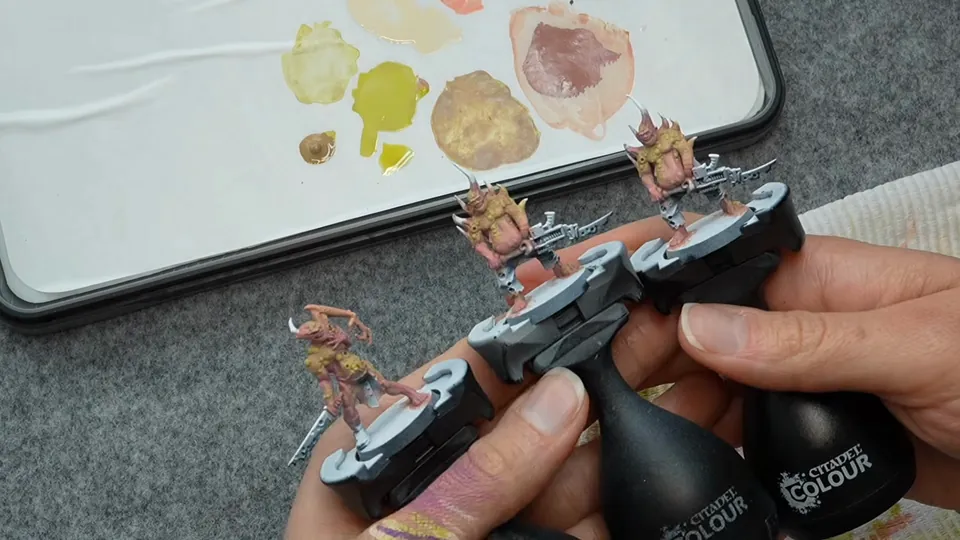
Three times, always as a way to get brightness back. In Episode 05, painting three Poxwalkers at once:
“I used a bright bronze. I gave the bronze a good wash to dirty everything down, then dry brush some of that brightness back into [it].” — Episode 05
In Episode 07, her biggest model, a wash left the armour flat:
“I found out I created another problem. I have lost all the brightness that I had in the armor. A few weeks ago when I tried copying Richard Gray, I learned this technique between wet blending and dry brushing. It worked very well on the Death Shroud. So, now I'm going to try it on something significantly bigger.” — Episode 07
Then on the metal: “And a quick dry brush to bring that metal back.” Her loop is the same each time: wash to add depth, then drybrush to restore the lift. More on that in how to paint metallics.
04Drybrush or edge highlight?
General practice: drybrush for rough, textured or large areas such as metal, fur, rock and cloth folds, because it is fast and hides small errors. Edge highlight for clean, smooth edges where you want a crisp line. She leans on both: in Episode 07 she counts about 500 edges on the model, and for the big metal areas she chose wash and a quick dry brush over lining every one. See how to highlight miniatures.
05What goes wrong with drybrushing?
General rules of thumb:
- Chalky, grainy look: too much paint on the brush. Wipe off more, and use thinner passes.
- Paint in the recesses: the brush was pressed in, not skimmed. Keep it almost flat and light.
- Too harsh a contrast: use a colour closer to the base, or soften with a thin wash or glaze.
- Wrecked brush: use a dedicated old brush.
See also common beginner painting mistakes.
Back to the full beginner's guide: what to buy, priming, washes and every mistake so far →
FAQ
- What is drybrushing in miniature painting?
- Drybrushing is dragging a brush that has almost no paint left across a model so the paint only catches the raised edges and textures. It is a quick way to add highlights. This is general painting practice. The Pigmentum uses it to bring brightness back after a wash.
- How do you drybrush a miniature step by step?
- Load a little paint on a brush, wipe most of it off on a paper towel until a test swipe leaves almost nothing, then brush lightly back and forth across the raised areas, building up in several light passes. This is general practice, not a claim about her exact brush or paint.
- When should you use drybrushing instead of edge highlighting?
- Drybrushing suits textured or rough areas, large metal areas and anything with many small edges, because it is fast. Edge highlighting suits clean, smooth edges. In Episode 07 she counts about 500 edges on her biggest model, and uses a quick dry brush on the metal rather than lining every edge.
- Why drybrush after a wash?
- A wash darkens the recesses but also dulls the raised areas. In Episode 05 she gave bright bronze a good wash to dirty it down, then dry brushed some of that brightness back in. In Episode 07, after a wash left her armour without its brightness, she did the same on the metal with a quick dry brush.
- Does drybrushing ruin your brushes?
- It is hard on bristles, so use an old or cheap brush and keep your best detail brush for detail. This is general practice; she has not said which brush she uses for it.