01What does a wash do?
This section is general painting practice, not something she has claimed. A wash is paint thinned until it runs. It flows into recesses, panel lines and the gaps between details, and dries darker there, which makes shadows and picks out detail in one move. On bare surface it leaves only a faint tint.
Washes are sold ready-made as “shades”, or you can thin your own paint (see how to thin paint).
02When do you apply it?
After the base colours, before the final highlights. That is also what she learned the hard way. In Episode 02 she says she spent ages putting highlights on her first miniature and then put a wash over it:
“I decided to put a wash over it. And after the wash, it looked absolutely nothing like the shades I just had spent so much time putting on.” — Episode 02
Hence the rule on this site: wash first, highlight after. The full reasoning is on the paint order page.
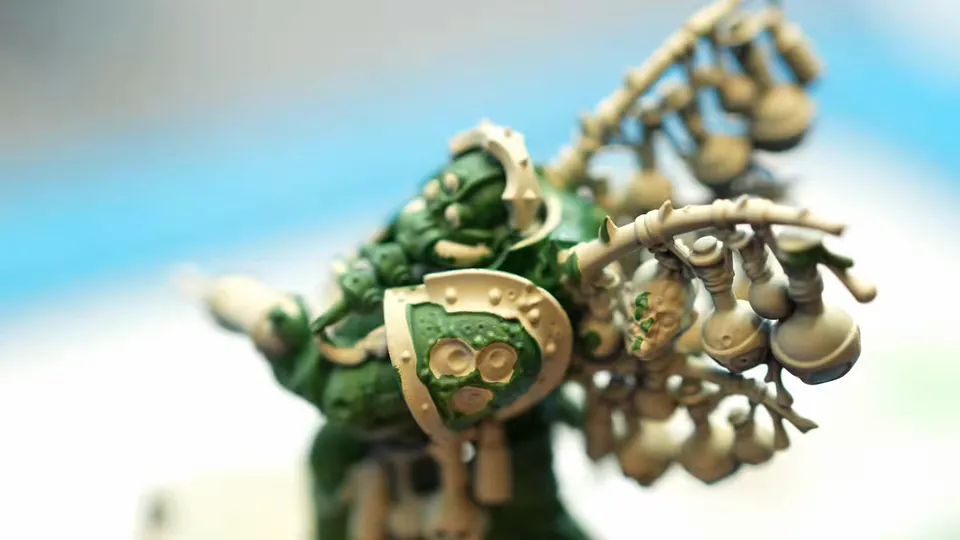
03How do you apply it, step by step?
General practice:
- Start from a dry, finished base coat. A wash grabs onto wet or patchy paint.
- Stir or shake the wash, because the pigment settles.
- Take a small brush load and touch it into the recesses, letting it flow along panel lines by itself.
- Lift off any pool on flat areas with a clean, slightly damp brush before it dries.
- Leave it completely dry. Touching it early smears it.
- Add a second wash only after the first is dry if you want it deeper. Several light washes beat one heavy one.
04What happened when she used one on camera?
Episode 07, the video where she paints her biggest Warhammer model, is the clearest. She introduces the wash step as the part she trusts herself with least:
“Every time I use a wash, one of three things happen. It pulls everywhere that I don't notice. I use way too much, and I turn the entire model five times darker. Or, my personal favorite, I get so impatient and I touch it before it dries. So, this time, my goal is very simple. Don't ruin this.” — Episode 07
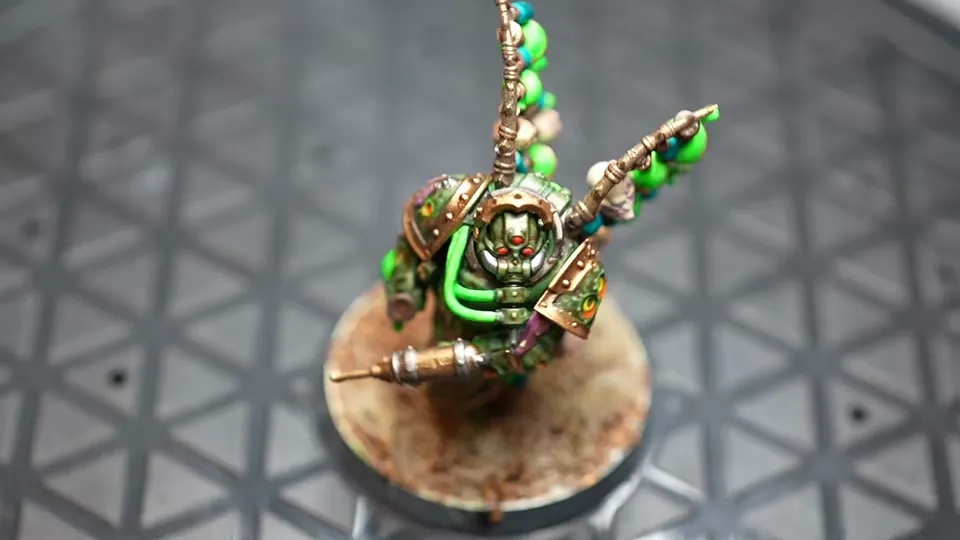
Her verdict: “Okay, it doesn't look too bad. Maybe I am allowed to use washes.” Then the problem from Episode 02 returned in a smaller form: the wash took the brightness out of the armour. Her fix was the technique she says sits between wet blending and dry brushing, learned copying Richard Gray, now applied to something much bigger.
On the metal she kept it simple: base coat, wash, bring the highlights back, then a quick dry brush. She jokes about doing another wash: “Apparently, we're friends now.” In Episode 05 she did the same with bronze, giving it “a good wash to dirty everything down” and dry brushing brightness back into it, and she mixed a purple wash around the bruised areas of her Poxwalkers.
The pattern across four videos: wash to darken and dirty, then restore the light on top.
05How do you fix a wash that went wrong?
General rules of thumb:
- Too dark overall: you cannot lift it once dry. Repaint the area with the base colour, thin coats, and wash again more lightly.
- Pooled stain on a flat area: re-wet it with a damp brush and blend the edge out, or paint over and redo.
- Lost your highlights: add them back on top, which is exactly what she did. Wet blending, dry brushing or edge highlighting all work.
- Smudged because you touched it: wait for it to dry, then correct with the base colour.
See also common beginner painting mistakes and how to highlight miniatures.
Back to the full beginner's guide: what to buy, priming, washes and every mistake so far →
FAQ
- How do you use a wash on a miniature?
- Load a brush with the wash, touch it to the recesses and panel lines, and let it flow into them. Wipe or lift off any excess that pools on flat areas, then leave it alone until it is fully dry. This is general painting practice. In Episode 07 The Pigmentum applied a wash to her biggest model and was surprised it came out okay.
- Do you wash a miniature before or after highlighting?
- Wash first, highlight after. In Episode 02 she layered highlights, put a wash over the whole model, and the highlights disappeared. In Episode 07 the wash again killed the brightness in the armour, and she brought it back with a technique between wet blending and dry brushing.
- Why did my wash go too dark?
- Usually too much wash was applied everywhere. She names this as one of her three wash problems in Episode 07: using way too much and turning the whole model darker. The common fix is a little at a time, targeted at recesses rather than flooded across the surface.
- Why does a wash pool and stain?
- Wash settles in low spots as it dries, which is the point, but excess left on flat areas dries as a hard-edged stain. Take the excess off with a clean, damp brush while it is still wet. Touching it before it dries can smudge it, another of her three problems in Episode 07.
- Can you use a wash on metal?
- Yes. For larger metal areas in Episode 07 she used a base coat, then a wash, then brought the highlights back, with a quick dry brush at the end. In Episode 05 she gave bronze a good wash to dirty everything down, then dry brushed some brightness back in.