01Why does paint need thinning?
This section is general painting practice, not something she has claimed. Paint straight from a pot or dropper is usually thicker than you want on a miniature. Thick paint fills recesses, softens sharp edges and leaves brush marks, so fine detail like teeth, rivets and faces disappears. It also dries in an uneven, patchy layer.
Thinned paint does the opposite: it settles into the surface, stays semi-translucent, and lets you build colour up gradually. That is also why a first coat can look rough. It is meant to be the first of several.
02How thin is thin enough?
The most repeated rule of thumb is skimmed milk: it should flow off the brush tip without pooling or running, and it should look a little translucent on the first coat. Starting ratios you will see quoted are around one part water to two or three parts paint, but brands differ, so judge by how it behaves rather than by an exact measure.
The other widely agreed rule: two thin coats beat one thick one. If the first coat looks streaky, that is normal. Let it dry and go again.
03How do you thin it, step by step?
- Put a little paint on a palette, not in the pot, so you never dilute your whole supply.
- Add a small drop of water or thinning medium next to it. Start with less than you think.
- Mix with the brush until the colour is even, then test the consistency on the palette or a spare surface.
- Wipe the excess off the brush on a tissue or the palette edge. A loaded brush floods detail even with thin paint.
- Apply a thin coat, let it dry, then check whether it needs a second.
Water is fine for most acrylic miniature paints. Too much water breaks the paint down and can leave it chalky, so add it gradually. A drop of a dedicated medium is a common alternative.
04What does she say about it on camera?
Honestly, not much, and we would rather say that than invent a lesson. Her thinning moments are two lines. In Episode 03, copying a Golden Demon winner, she lists what she is already learning:
“I'm already learning the highlights, the shadows, the edge highlighting, the blending, and how to thin my paint properly.” — Episode 03
By Episode 05, batch painting three Poxwalkers, she uses thin paint deliberately:
She says she started the skin with Heavy Skin Tone, “keeping the paint really thin,” so that some of what was underneath could still come through. — Episode 05
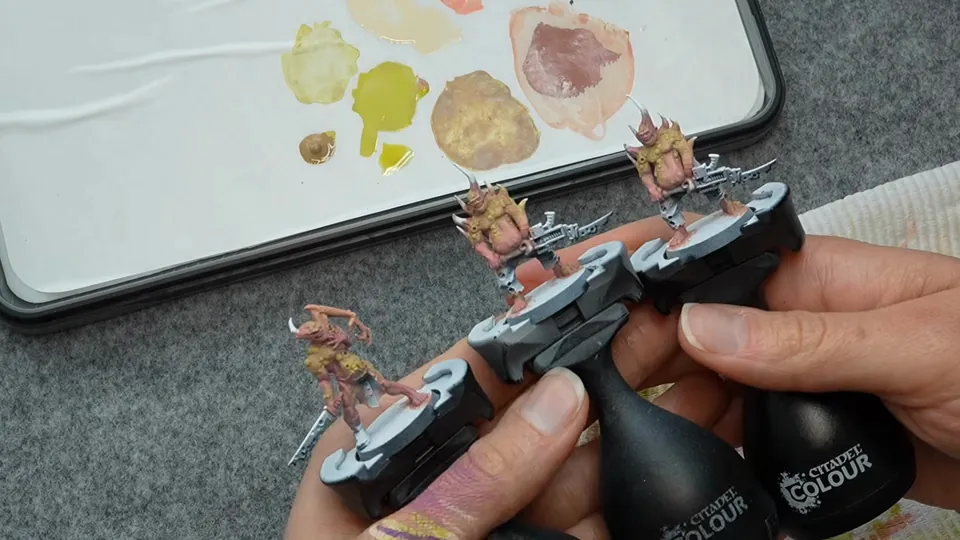
That is the useful idea behind thinning in one sentence: thin paint is not just easier to apply, it lets the colour underneath show through, which is how you get depth from skin without a flat, opaque coat. She also describes her first colours on the Golden Demon copy as looking “very patchy” at first, with the shapes only coming together once all the colours were on, which is what thin early coats feel like.
05Signs your paint is too thick or too thin
General rules of thumb:
- Too thick: brush marks visible, detail clogged, paint drying in ridges or a gritty, lumpy surface.
- Too thin: paint runs into the recesses, pools, or looks chalky and see-through even after two coats. Mix in a little more paint or go back to thinner coats rather than adding more water.
- About right: flows from the brush tip, covers in two coats, and you can still read the surface detail underneath.
If a colour has already gone wrong, see common beginner painting mistakes, and for the order to apply layers in, the paint order page. If thin coats make it take longer, the timings page shows her real times.
Back to the full beginner's guide: what to buy, priming, washes and every mistake so far →
FAQ
- How do you thin paint for miniatures?
- Add a small amount of water (or a dedicated thinning medium) to the paint on your palette and mix it until it flows off the brush without pooling. Commonly recommended starting points are roughly one part water to two or three parts paint, then adjusting by eye. In Episode 05 The Pigmentum kept her skin tone paint really thin so some of the colour underneath could come through.
- How thin should miniature paint be?
- A common description is about the consistency of milk or skimmed milk: it should cover with two thin coats, not run into the recesses, and leave the surface detail visible. This is general painting practice rather than an exact ratio, which varies by brand.
- Do you have to thin paint for miniatures?
- Paint straight from a pot is usually thicker than ideal for miniatures, so most painters thin it at least a little. Thick paint hides detail and dries patchy. Among the skills The Pigmentum lists learning by her second miniature in Episode 03 is how to thin her paint properly.
- Can you use water to thin miniature paint?
- Yes, for most acrylic miniature paints, water is the usual choice, and many painters add a drop of a medium or flow improver for smoother coverage. Too much water makes paint lose its binder and go chalky, so add it in small amounts.
- Why does my miniature paint look patchy?
- Usually the paint is either too thick or applied in one heavy coat. The common fix is two or more thinner coats. Patchiness at the first layer is also normal, and The Pigmentum describes her Episode 03 colours as looking very patchy at first before the shapes came together once the colours were on.